Skills vs Degree: What Helps You Build a Better Career?
For many years, getting a degree was considered the most important step toward building a successful career. Students spent years studying at universities with the belief that a degree would automatically lead to a good job and a stable future.
Today, the career landscape is changing. Employers increasingly want candidates who can demonstrate what they can actually do, while technology is changing the skills needed for many jobs. This has created an important question for students and job seekers:
Are skills more important than a degree, or do you need both to build a successful career?
The truth is that the answer is not simply skills vs degree. A degree can provide academic knowledge and open certain career doors, while practical skills help you perform real tasks and adapt to changing workplace demands. For most people, the strongest career path combines education with practical, job-ready skills.
What Is the Difference Between a Degree and Practical Skills?
A degree is a formal academic qualification earned after completing a structured program of study. It usually provides theoretical knowledge, subject understanding, and an academic foundation in a particular field.
Practical skills, on the other hand, are the abilities you can apply to complete real-world tasks. These may include:
- Graphic designing
- Website development
- Digital marketing
- SEO
- Google Ads
- MS Office
- Amazon and e-commerce skills
- Communication
- Problem-solving
- Project management
A degree may tell an employer what you studied, while practical skills can demonstrate what you are capable of doing.
Why Does a Degree Still Matter?
Although practical skills are becoming increasingly valuable, degrees are still important in many career paths.
1. A Degree Provides Academic Knowledge
University education gives students a structured learning environment and a deeper understanding of a subject. It can help develop research, analytical, and theoretical knowledge.
For careers such as medicine, law, engineering, teaching, and other regulated professions, formal education and recognized qualifications may be essential.
2. A Degree Can Help You Meet Job Requirements
Many employers still list educational qualifications as part of their hiring requirements. A degree can help you qualify for certain positions and may be necessary for career progression in some industries.
3. A Degree Demonstrates Commitment
Completing a degree requires time, effort, discipline, and consistency. These qualities can show employers that you are capable of working toward a long-term goal.
However, a degree alone does not guarantee career success. Employers also want to know whether you can apply knowledge and perform the tasks required for a job.
Why Are Practical Skills Becoming More Important?
The modern workplace is changing rapidly. New technologies, digital tools, and artificial intelligence are changing the way people work. As a result, employers increasingly value candidates who can demonstrate relevant, up-to-date abilities.
Research on emerging professions has found that skill-based hiring is becoming more common in areas such as AI, while demand for relevant technical skills can be particularly valuable in fast-growing fields.
1. Skills Help You Perform Real Tasks
A person may have excellent academic knowledge, but employers also need people who can complete real work.
For example, a digital marketing professional may need to know how to:
- Perform keyword research
- Optimize a website for search engines
- Create digital marketing campaigns
- Manage online advertisements
- Analyze campaign results
These abilities are developed through practice and hands-on learning.
2. Skills Can Help You Build a Portfolio
A portfolio can provide evidence of your abilities. Instead of only telling employers what you can do, you can show them examples of your work.
A portfolio may include:
- Website projects
- Graphic design work
- SEO projects
- Digital marketing campaigns
- Social media content
- Business presentations
- Freelance projects
This is particularly valuable in digital and creative careers.
3. Skills Can Create Freelancing Opportunities
One major advantage of practical skills is that they can create opportunities outside traditional employment.
People with valuable skills can offer services to clients through:
- Freelancing platforms
- Social media
- Personal websites
- Professional networking
- Direct client outreach
Skills such as digital marketing, graphic designing, website development, and e-commerce can be used to provide services to clients locally and internationally.
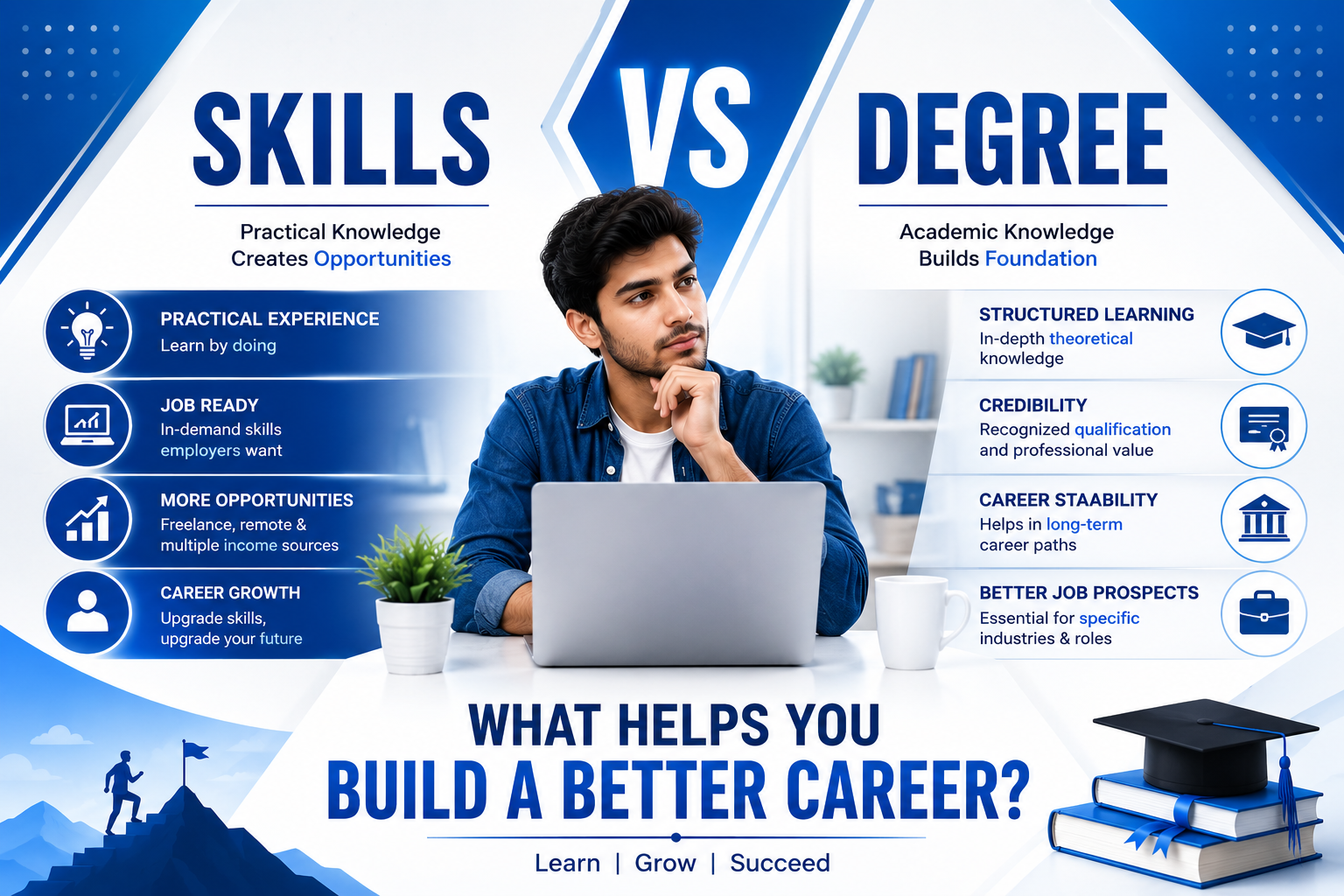
Skills vs Degree: Which One Is Better?
The answer depends on your career goals.
If you want to enter a profession that requires formal qualifications, a degree may be essential. However, if you want to work in digital marketing, design, website development, freelancing, or other practical fields, relevant skills and experience can be extremely important.
The best approach is not always to choose between a degree and skills. Instead, you should consider how both can work together.
A Degree Can Help You:
- Build academic knowledge
- Meet formal job requirements
- Qualify for specific professions
- Develop a foundation in a subject
- Improve long-term career opportunities
Practical Skills Can Help You:
- Become job-ready
- Build a professional portfolio
- Gain real-world experience
- Start freelancing
- Adapt to changing technology
- Demonstrate your abilities to employers
Why the Combination of a Degree and Skills Is Powerful
A degree and practical skills can complement each other.
For example, a person with a business degree who also learns digital marketing may understand both business concepts and modern online promotion. A student studying computer science who develops practical website development skills can combine academic knowledge with real-world technical abilities.
This combination can make a candidate more competitive because they possess both knowledge and the ability to apply it.
What Skills Should Students Learn Alongside Their Education?
Students should consider developing skills that are relevant to their career goals and the changing job market.
Digital Skills
Digital skills are valuable across many industries. These may include:
- Digital marketing
- SEO
- Online advertising
- Website development
- Graphic designing
- E-commerce
Communication Skills
Good communication is important in almost every career. Employees need to communicate with colleagues, clients, customers, and managers.
Problem-Solving Skills
Employers value people who can identify problems, think critically, and find effective solutions.
Time Management
The ability to organize tasks and meet deadlines is essential for students, employees, freelancers, and business owners.
Adaptability
Technology and workplace requirements continue to change. The ability to learn new tools and adapt to new situations is becoming increasingly important. Recent discussion of workplace skills emphasizes adaptability, learning speed, critical thinking, and the ability to work effectively with new technologies.
The Future of Careers: Education Plus Skills
The future of work is likely to place greater importance on a combination of academic knowledge, practical abilities, adaptability, and continuous learning.
A degree can provide a strong foundation, but skills help you apply knowledge in real-world situations. At the same time, practical skills without a strong foundation may not be enough for careers that require formal education.
The most effective career strategy is to understand your goals and build the right combination of education, practical skills, experience, and continuous learning.